
Business
-
Die Cut: Custom Packaging Solutions That Enhance Brand Visibility and Sustainability
In today’s fast-paced retail and e-commerce landscape, packaging is no longer just about protection—it’s a key brand ambassador. In New Zealand, where businesses are increasingly embracing sustainable practices and looking to stand out in crowded markets, die-cut boxes are emerging as a powerful packaging solution. Designed with precision, flexibility, and aesthetics in mind, these boxes provide a professional and eco-conscious approach to elevate brand identity, enhance product presentation, and minimise environmental impact.
Let’s explore how die cut boxes are shaping the packaging industry in New Zealand and why they’re an ideal choice for businesses seeking a strategic edge.
What Are Die-Cut Boxes?
 Die-cut boxes are custom-designed packaging solutions made using a die-cutting machine that cuts, shapes, and scores cardboard or corrugated board to fit specific product dimensions and designs. Unlike standard boxes, which come in fixed shapes and sizes, die-cut boxes can be tailored to meet unique branding, marketing, and structural requirements.
Enhancing Brand Visibility with Custom Packaging
In New Zealand’s competitive retail and e-commerce space, first impressions matter. Die-cut boxes provide a visual and tactile branding opportunity that starts from the moment a customer sees the package.
Tailored Design That Reflects Brand Identity
With die-cut boxes, brands can incorporate custom shapes, printed graphics, windows, compartments, and embossing—all of which contribute to a consistent and memorable unboxing experience. It is particularly important for small to medium-sized New Zealand businesses that want to build a loyal customer base through a professional presentation.
Improved Shelf Appeal and Consumer Engagement
Retail packaging must compete for attention. Die-cut boxes, with their high degree of customisation, are better positioned to stand out on shelves. The strategic use of bold colours, textured finishes, or custom die-cut openings can immediately differentiate a product, drawing consumers in and increasing purchase intent.
Sustainability: A Growing Priority for NZ Businesses
New Zealand’s environmental consciousness is reflected in consumer preferences. Buyers are increasingly supporting brands that take sustainability seriously, and packaging plays a central role in these decisions.
Eco-Friendly Material Options
Most die-cut boxes in New Zealand are manufactured using recyclable materials such as kraft board, corrugated cardboard, and biodegradable coatings. Many local manufacturers also offer FSC-certified options to ensure responsible forestry practices.
By choosing recyclable or compostable die-cut packaging, Kiwi businesses not only reduce landfill waste but also align with New Zealand’s national goals for waste minimisation and circular economy development.
Right-Sized Packaging Reduces Waste
Because die-cut boxes are custom-fitted, they reduce excess material use and avoid the need for additional fillers. This minimised packaging not only cuts down on shipping costs but also limits carbon footprint during distribution—another win for sustainability.
Applications Across Key NZ Industries
The versatility of die-cut boxes makes them suitable for a wide range of industries in New Zealand. Each sector benefits from unique design and structural advantages that these boxes offer.
Retail and Boutique Brands
Clothing, accessories, skincare, and boutique food products all benefit from elegant, branded die-cut boxes. These packages double as display units and customer takeaways, helping small businesses build a premium brand image without incurring high costs.
E-commerce and Subscription Services
Online retailers and subscription box providers rely on sturdy, tamper-resistant packaging. Die-cut boxes can be designed with locking tabs and inserts to secure products during transit. The unboxing experience also becomes more engaging, essential in an age of social media reviews and customer-generated content.
Agriculture and Food Packaging
From organic teas to gourmet cheeses, New Zealand’s rich agricultural sector benefits significantly from custom die-cut packaging. These boxes can be food-safe, ventilated, and printed with origin stories that connect consumers with local producers, allowing them to share their unique stories.
Electronics and Tech Startups
Die-cut inserts protect sensitive electronic components while offering a sleek presentation. Startups in Wellington or Christchurch can use these boxes to reinforce innovation and quality through innovative, practical packaging design.
Conclusion:
In New Zealand’s dynamic business environment, die-cut boxes are proving to be an invaluable tool for enhancing brand presence and aligning with green values. With endless customisation options, eco-friendly materials, and widespread applicability across industries, they’re helping Kiwi businesses deliver packaging that’s as smart as the products it protects.
As demand for sustainable and distinctive packaging continues to rise, now is the time for New Zealand companies to explore how die-cut boxes can elevate their brand to new heights.
-
RFID Tags and Readers
RFID tags allow people to be tracked more effectively using credit cards, passports and other identification sources than would be possible or practical using traditional bar codes; however, such tracking poses serious privacy issues.
RFID tags use radio waves to communicate with reader devices without line of sight, using an integrated circuit (IC) and antenna.
RFID Technology
RFID tags – RAMP, or Radio Frequency Identification, is a wireless technology that uses radio waves to transmit and receive data. It comprises two components – tags and readers. A reader sends electromagnetic signals to a tag which then responds by providing its location and state details. RFID readers identify products by reading tags with serial numbers or unique identifiers stored on them. An antenna with both transmitter and receiver capabilities connects directly with an RFID transceiver reader which can either be fixed or mobile depending on its application. There are various kinds of RFID readers, ranging from passive tags (which don’t have their own power source and can only be read within 4 inches of a reader) and active RFID tags with built-in power sources that allow greater distance reading (up to 100 meters); NFC tags that connect directly with mobile phones for near field communication provide close proximity communications between an RFID tag and its target device.
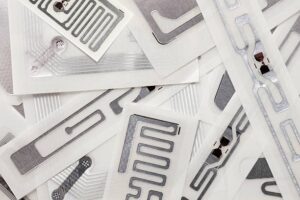 Retailers rely on RFID tracking technology to track merchandise from warehouse shelves to the sales floor, eliminating out-of-stock situations and improving inventory management. Furthermore, this system helps prevent theft and product loss as well as theft prevention measures such as tracking theft via stolen tags or theft prevention technology. Furthermore, retailers can combine the system with sensors that measure temperature, movement or any other factors which might compromise product quality.
RFID scanners offer several advantages over barcodes: they can rapidly scan multiple tags at the same time, relieving staffers of having to read and record individual pieces of data manually; plus they can verify packaging integrity more efficiently than barcodes alone.
Passive RFID tags – RAMP tags are typically maintenance-free and built for robust operation, yet there may still be factors that hinder their readability from a distance. Exposing an RFID tag to metal or water may impede its reading ability; similarly, extreme temperatures, humidity or moisture conditions could potentially damage it over time and degrade its functionality over time.
RFID is an exciting new technology with enormous potential to increase supply chain efficiency and enhance customer experiences. Companies looking to remain competitive on a global market should seriously consider making an investment into this tool.
Substrate
The substrate serves as the backbone for tag components to assemble on. Usually constructed out of flexible material, its composition and thickness must meet environmental conditions that the tag will encounter during its lifespan; such as chemical resistance, heat tolerance, electrical stability under various conditions, smooth printing surfaces for antenna layout, dissipating static build-up dissipation, as well as protecting components and their connections from mechanical forces.
The integrated circuit (IC) of an RFID tag is its brain. It contains memory to store data and a microprocessor to make decisions; power can come either passively from inductive coupling generated by interrogator antenna or active from batteries; additional features of an IC may include radio transmission system that modulates and demodulates signals while also encoding/decoding digital bits, storage of tag ID/object ID data as well as error detection codes such as Cyclic Redundancy Code.
An antenna is created on a substrate by depositing or printing thin metal strips composed of copper, silver, aluminium and other elements onto it at high speeds using one of three methods: copper etching, foil stamping or screen-printing – although screen-printing produces antennas less efficiently than either other option.
Numerous research efforts are directed toward optimizing substrate performance. A number of papers report using conducting polymers like PEDOT:PSS to create more conductive substrates, with excellent conductivity, good stability under extreme conditions and low cost – in addition to being eco-friendly and biocompatible.
An effective substrate is integral to the success of RFID tags – RAMP. A good substrate should have high electrical conductivity and low temperature coefficient, enabling faster data transmission with minimal thermal effects. Furthermore, it should withstand abrasion, humidity and chemicals before finally being secured to objects so as to maximize contact.
IC
Integrated circuits (ICs) are at the core of RFID tags, encoding information about themselves to send to an RFID reader (also known as an interrogator) using radio waves. There are two kinds of RFID readers: passive and active readers – passive readers use electromagnetic energy to power passive RFID tags with up to 25 meters read range, while active RFID tags have their own power source like batteries that allow for greater range operations than passive readers.
RFID falls under the umbrella term of Automatic Identification and Data Collection (AIDC), which refers to technologies which help detect items, identify them automatically and collect their data automatically before transmitting it back into a computer system. They can be used for inventory tracking, security management or service delivery – making RFID technology an invaluable asset in retail with respect to inventory accuracy and checkout times.
RFID offers retailers many benefits beyond increased stock reliability, such as its unique identification feature. Unlike barcodes, each RFID tag can store an enormous amount of data about an item giving it its own identity which helps prevent theft or counterfeiting – both issues which pose major threats for some businesses.
Many companies are adopting RFID to increase efficiency and lower costs, with Ralph Lauren having created its own virtual fitting rooms using this technology to display clothing options on a live image of each customer as well as recommend complementary styles and provide product information.
HID Global provides the widest selection of RFID tags – RAMP and transponders, backed by over two decades of research, development, and manufacturing expertise. Our team of experts is always on hand to answer questions or select suitable tags for any application – get in touch today to start exploring!
Antenna
RFID tag antennas are essential components of their design. Their main job is to generate radio-frequency (RF) waves capable of reaching RFID chips while withstanding environmental conditions. Antennas for these tags come in all sorts of shapes and sizes; small flat antennas may suffice, while others feature coil or dipole designs for optimal performance. Their shapes affect how efficiently RF waves can be generated which in turn determine their performance.
Antenna miniaturization can be a formidable challenge for RFID sensor tags that are intended to be integrated in everyday objects, such as pill bottles. A conventional antenna’s longest linear dimension often exceeds what fits within an object’s dimensions and shape, so miniaturization techniques for antennas may reduce their length by 10 and increase maximum antenna gain.
RFID tags must also be water and dust-resistant in order to function effectively, since RF identification can occur in virtually any environment and must remain reliable. Furthermore, ambient temperature can have a direct influence on antenna performance; its maximum operating temperature depends on both its type and composition of materials used in its creation.
RFID chips (also called integrated circuits) are another key element of an RFID tag, featuring a microprocessor to make decisions and memory storage for data. Energy to power this microprocessor comes from either battery power in active tags, or radio waves from reader antennae in passive tags.
This paper describes a paper-based flexible UHF RFID tags – RAMP antenna designed using a semi-circular feed network with meander line radiating elements printed onto photo paper with silver nanoparticle conductive ink, providing excellent flexibility and environmental friendliness. Furthermore, its authors investigated how different printing techniques affected its performance: spray coated antennas resonated well in the target 902-928MHz band while stencil printed and screen-printed antennas also achieved resonance at 902-928 MHz frequencies.